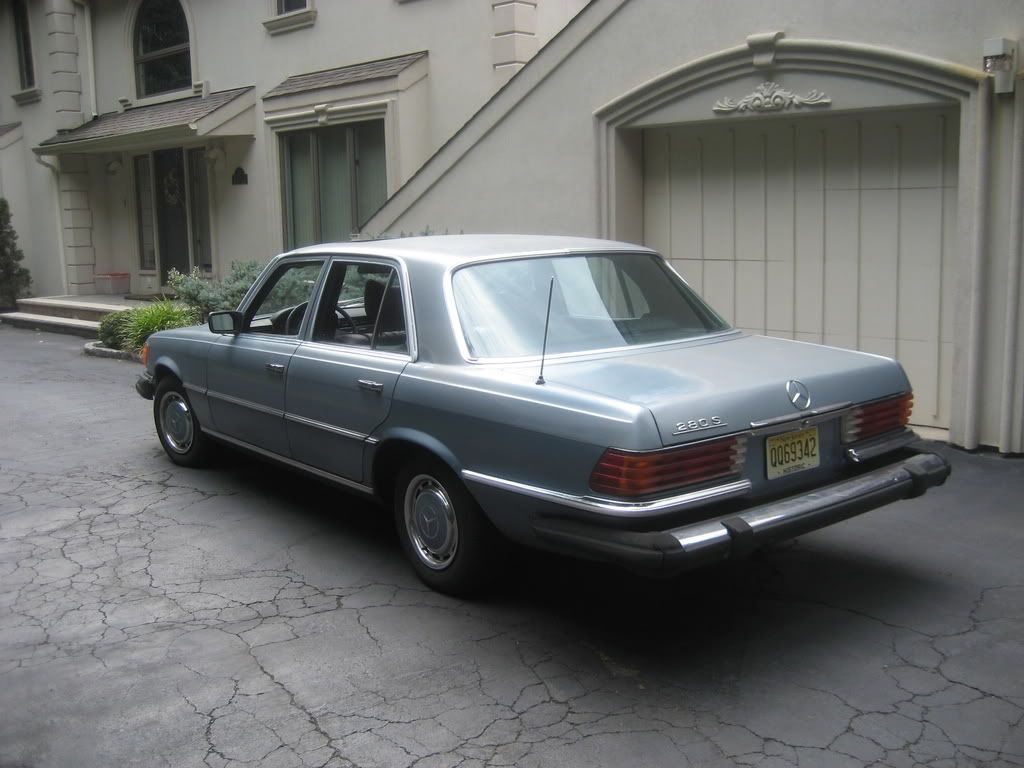
 They really don’t build them like they used to. Really. I have yet to come across a car that’s just as well built and solid as an old Mercedes, say pre-1998 before the finalizing of merging Chrysler and DaimlerBenz AG, even by the guys from Stuttgart themselves today. If a car was to be elected as the pinnacle and benchmark for build quality and solidity, quite obviously look no further than Mercedes-Benz, and the barn-found 1975 280S that I picked up as a restoration project.
The car to always set the standard and premiere safety and automotive technology innovation was the Mercedes-Benz S-Class. It was built to standards that absolutely no other car manufacturer could match and still is to this day. The W116 S-Class—the first Mercedes luxury sedan to be called the S-Class, or Sonderklasse or “special class” after the W108/W109—was the car that was used to develop the Anti-Lock Braking System (ABS, co-developed with Robert-Bosch GmBH), a more reinforced passenger cell with a stronger roof structure, and increased deformation for energy dissipation on the front and rear crumple zones (Mercedes was the first with both a reinforced passenger cell and crumple zones).
Driving the 280S is like driving a piece of pure automotive history. So much development, research and technology went into and came from cars like the 280S and you really learn to appreciate how special and way ahead of their time these cars were, especially one like the S-Class.
Observing the wedged-three-box, this car obviously screams old-school, but with class just following. It has a lot of presence which is very much elegant in nature as well. It even make
 s old Rolls-Royces and Bentley’s appear barbaric in comparison in my tastes. But of course, an old Rolls is an old Rolls, yet the 280S still screams elegance without the “rich snob” part. Heavily inspired by the R107 450SL roadster and coupe that debuted several years earlier than the W116 S-Class, it’s easy to tell the cars are siblings, following the usual Mercedes form following function and departing from the vertical headlight equipped W108/W109 of the previous generation. Wrap around turn signals, front and rear, were designed that way for better visibility and safety. The wedge shape keeps the car aerodynamic without overwhelming proportions unlike, say an Eldorado from the same era. It again all comes across as sleek, elegant and tasteful, with a broad shoulder line that complements the sheer monstrosity of the car, making it feel very masculine.
And what a monstrosity at is. The 280S, with its extended US-Spec 5-MPH bumpers (you older folks remember those from the older days) is a full 17 feet long, which bests the current Chevy Tahoe by a full two inches and the last generation Tahoe by a whopping 5 inches. And a wide sucker the 280S is as well at 73.6 inches, and height seems like the only proportion that’s properly normal at 5
 6.3 inches. Surprisingly though, this car really is no bigger than the current W221 S-Class, though it does feel more massive due to its wedged design.
Pulling on the protruding chrome door handles yields a very strong metallic clank and the feel of pulling open a door that belongs in Fort Knox. Sitting in the therapeutic bucket seats and you immediately imagine yourself taking this car on a long road trip without any complaints. Although the interior is a little warped from sitting for about a year outside—not to mention its 34 years old—the interior held up quite well. All materials and surfaces are soft to the touch but with the solidity of a Swiss bank vault behind it. Stoic, Teutonic, and dark; typical words to describe the traditional German automobile interior, this one in particular in black. The monstrous dash stretches across the entire width of a car with not much to brag about except for a strip of wood lining the center. Just like my E320 I previously reviewed, climate and radio ergonomics are a little less than spectacular as designs are very similar. Switchgear all maintains its tactile and firm feel but are a little hard to distinguish one from another unless you either read their icons or memorize where they are.
Moving on…as some of you have probably heard other people say, there’s nothing like driving an old Mercedes-Benz. And just like the statement:
 they really don’t build them like they used to, it’s true. Driving this old, stately relic of an S-Class gives you the confidence that you’re driving around in Buckingham Palace. And while the giant proportions of the 280S will give you the first impression that you’ll be wallowing and wafting and understeering before you even turn the wheel more than a quarter of the way, don’t mistaken yourself. This car is a blast to drive: and while a Porsche or a BMW would be buckets of fun to drive because of their performance capabilities, the old 280S demands a different approach. It requires a certain approach that you either get or don’t get. It’s very hard to explain but I’ll try my best.
In today’s day and age, this car will not win any awards for power. The 2.8-Liter DOHC Straight-Six, dubbed the M110, is a big and thirsty engine…but not with any fair exchange for power since it is carbureted. Rated at 160HP and 167 ft lbs of torque peaking at 5,500 and 4,000 RPM respectively going through a short-ratio four-speed automatic, the 280S’s power is adequate around town but steep inclines and highway driving demand lots of wide open throttle and downshifting just to keep up with traffic. It’s very little power to motivate about 3800 lbs worth of German steel. So you could imagine that its fu
 el economy isn’t exactly the best with its rating of 12 MPG city and 17 MPG highway. Back in the days of the fuel crisis and the phasing out of leaded fuel though these numbers and performance figures were very tolerable. Zero to sixty clocks in at about 11 seconds and the top speed clocks in at about 120MPH. Not bad for 1975…but we’re not longer wearing bell-bottoms and it ain’t about the sex, drugs and rock-n-roll any more. Although very barbaric in comparison to the current variable this and electronic controlled that, the M110 is so refined that it rivals many modern straight sixes found today and within the last decade or so. Power delivery is smooth and progressive despite it being in low for modern standards. And boy does it like to rev.
Handling is where this car shines. Using all of the technology obtained from the famed C111 development test car, the 280S sports a double wishbone suspension with a torsion bar stabilizer up front keeping offset and camber exactly at zero. Progressive anti-dive geomtery was added to keep the body stable under hard braking. The once camber-change susceptible diagonal swing axle in the rear—the one that made the Chevrolet Corvair such a dangerous car to drive—was modified with control arms to keep the camber change at bay, just like the front with zero offset and camber. The result is Mercedes’ traditional firm yet very compliant ride quality. This car will absorb potholes, dips, dives, imperfections like a champ. Absolutely nothing can upset the chassis of this car. It has such a surefooted stance that it seems like it’s unstoppable. But this is just one of the two handling personalities that the 280S posesses.
Take the 280S on a long sweeping and curvacious road and control the transmission via the shift gate and this car will sweep a corner with the stance and grace of Pomp and Circumstance; the car will feel like it transforms into something half its size. With a near-50/50 weight distribution and well thought out suspension tuning and stiff chassis, neutral handling is the name of the game with understeer and oversteer both kept well in check. Mercedes designed the 280S’s handling limits to be very far out of reach, making this car very easy and safe to drive, with plenty of potential available. Though far from being a Porsche or BMW, the 280S is a perfect example of Mercedes-Benz’s ideology offering the best of both worlds with performance and comfort. Lateral body motions are well controlled thanks to the 280’s wide track. Its recirculating ball-type steering provides enough feel and feedback to let you know when the front wheels start to lose grip. And while this car does not hide its massive size and bulk, it’s so easy to drive that it’s not much more of a task to maneuver than say your average Honda Accord. At 2.7 turns lock-to-lock and with a large diameter steering wheel, parallel parking couldn’t be any easier in a car this big.
It’s amazing to think that this was a car that came from over three decades ago. I can’t imagine how ahead of its time this car was, let alone it’s more expensive siblings, the 450SEL and the legendary 450SEL 6.9. The only things that are keeping me from enjoying this car to its full potential are all restoration and age related. If only Mercedes were to build their cars like they did in the time that this W116 was, not only would Mercedes have maintained their reputation, but they’d continue to seriously make the best cars in the world.
~Chris Chin


